New Enforcement Tools for Wage Theft Judgments

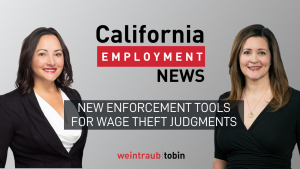
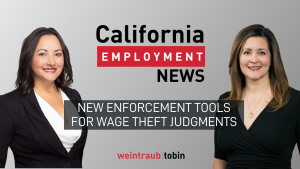
In this episode of California Employment News, Weintraub Tobin attorneys Shauna Correia and Meagan Bainbridge discuss SB 261, a new law that strengthens enforcement of California wage judgments. Learn about the new public database for unpaid judgments, triple penalties for late payment, and mandatory attorney’s fees for enforcement.

Watch this episode on the Weintraub YouTube channel.

Show Notes:

Shauna: Thank you for joining us for this installment of the California Employment News, an informative video and podcast resource offered by the Labor and Employment group at Weintraub Tobin. My name is Shauna Correia. I’m the practice group leader, and I’m joined today with my partner, Meagan Bainbridge. Today we’ll be talking about Labor Code enforcement tools that were recently greenlighted by Governor Newsom. Meagan, can you start us off by providing some background on this new law?

Meagan: Yeah. So, for context, if a judgment is issued against a defendant employer for a wage claim filed by an employee before the Labor Commissioner, under the current Labor Code, what have the proceedings under the Labor Code and Civil Code allowed for simple interest to accrue on a judgment until that judgment is paid. However, the legislature believed that this was not a strong enough incentive to promptly pay judgments owed or to deter employers from violating the Labor Code in the first place. So, Shauna, do you want to kind of talk through what the new regulations allow for and what those tools being provided are?

Shauna: So the stated intent behind SB261 is to provide these additional tools to enhance enforcement and collection of wage judgments in order to ensure victims of wage theft are paid in a timely manner. And so the new law, as enacted, requires the creation of a public database of employers who have unsatisfied wage judgments against them. And that would be searchable online in order to increase accountability. Megan, this new law will also provide some new penalties to incentivize prompt payment of judgments, right? Yeah.

Meagan: So, a new labor code section, section 238.05, is being added that allows for a civil penalty of up to three times the judgment, plus accrued post-judgment interest for non-payment of any judgment that remains outstanding for more than 180 days after the deadline to appeal has passed. 50% of this penalty will go to the employee. The other 50% will go to the Division of Labor Standards Enforcement. And the new law also makes mandatory an award of attorney’s fees and cost to the employee or the public prosecutor, whoever has to enforce the judgment. Well, those are some powerful enforcement incentives.

Now, there is a way for employers to avoid these penalties even if they were delinquent in paying a judgment, which is that if they work with the employee and they reach an accord as outlined in Labor Code Section 238 prior to the deadline, and they comply with the terms of the agreement, such as if it calls for installment payments, then that the penalty would not be imposed. Thanks, Shauna. And that’s it for now. You can continue to find our video series and podcast through the lelawblog.com on the Weintraub Tobin YouTube channel or wherever you listen to your favorite podcasts. Thank you everyone for joining us and we look forward to reconnecting on the next edition of California Employment News.

Shauna: We’ll see you then. Thanks.

Read More →

Farmworker Safety and Wage Protections

California Workers’ Rights Daily Digest – October 20, 2025

Welcome to today’s briefing on workers’ rights in California, highlighting protections for low-wage sectors like agriculture, warehousing, and construction. Sourced from official and advocacy channels, we feature timely safety reaffirmations and funding boosts.

Recent Developments

  • Farmworker Safety and Wage Protections: During National Farm Safety and Health Week, state agencies spotlighted Senate Bill 846, signed in July and effective January 1, 2026, which updates a 50-year-old lien statute to let agricultural workers secure up to two weeks of unpaid wages without prior restrictions on farm ownership types. This combats wage theft in ag by simplifying recovery processes.
  • Rural Outreach Expansion: The Rural Strategic Engagement Plan (RSEP), funded with $30 million over three years, recently held its first cross-training session in September for over 200 staff, enhancing coordination for farmworker services like enforcement and referrals. Seven organizations now host community clinics for direct access.
  • Apprenticeship Investments: $30 million awarded in October to 70 programs supports over 11,000 apprentices in sectors like education and manufacturing, offering paid training pathways for low-wage workers transitioning to stable roles, such as early care apprenticeships for economically disadvantaged groups.

Enforcement Actions

  • Heat Safety Advisory: Amid forecasts of 90°F+ temperatures, Cal/OSHA issued a September advisory enforcing heat prevention standards, with high-heat protocols (e.g., employee monitoring) mandatory at 95°F for agriculture and construction to prevent illnesses in outdoor labor.

Tips and Resources for Workers

  • Heat Hazard Prevention: In agriculture or construction, demand shade at 80°F+, cool-down breaks, and training; indoor warehousing requires similar at 82°F. Join the Heat Illness Prevention Network for updates via [email protected].
  • Farmworker Education Tools: Access the multilingual Campo Seguro site through the SAFE Program for safety trainings and rights info; it has reached 1.4 million since 2020, including indigenous communities.
  • Career Training Funds: Explore $26 million in EDD/ETP grants for farmworker skill-building toward higher wages and union pathways.

Keep advocating—resources at dir.ca.gov and labor.ca.gov. See you tomorrow!

Read More →

Incomplete wage statements, forcing staff to work while ill and obscuring their earnings.

California Wage Theft Alert – October 19, 2025

Hello, equity enforcers! Our perusal of the California Department of Industrial Relations (DIR) latest updates indicates no new citations or enforcement actions from the Labor Commissioner’s Office today.

Spotlight: Restaurant Wage Theft – Sick Leave Denials and Wage Discrepancies

Amid ongoing challenges in the food service sector, employers frequently withhold paid sick leave and furnish incomplete wage statements, forcing staff to work while ill and obscuring their earnings. This exacerbates health risks and financial instability for low-wage employees in suburban eateries. Today’s feature spotlights an Orange County enforcement action that combines citations and litigation, demonstrating DIR’s multifaceted approach to recover entitlements through the Healthy Workplace, Healthy Families Act.

February 27, 2025: Buena Park Restaurant Issued Over $1.1 Million in Penalties for Wage and Sick Leave Violations

  • Employer: Food Source LLC
  • Location: Buena Park (enforcement from Santa Ana)
  • Workers Affected: At least 90 total; 73 compensated via citations
  • Violations: Unpaid wages, overtime, and contract wages; liquidated damages; incomplete wage statements; denying paid sick leave access/documentation on stubs; failing to inform of rights; no COVID-19 supplemental sick leave
  • Amounts Assessed: Over $1.1M total—$532,561 in citations for wage theft (to 73 workers); $575,803 in lawsuit for sick leave violations/penalties
  • Case Overview: LCO’s action targets systemic non-compliance with California’s sick leave laws since 2014. Urges workers to contact hotlines for claims; part of broader outreach like Reaching Every Californian to combat such abuses.

Labor Commissioner Lilia García-Brower stated: “Employees should not be forced to choose between their health and earning a livelihood. My office is committed to ensuring workers are properly paid for their labor and receive all the benefits they earn and rightfully deserve.”

This case supports BOFE’s recoveries surpassing $43M since 2022, emphasizing integrated enforcement.

Restaurant Protections: Sick Leave, Wages, and Statements

  • Key Rights: Accrue 1hr sick leave/30hrs worked (up to 48hrs/year, usable after 90 days); overtime at 1.5x/2x; complete stubs detailing hours, rates, deductions, sick leave balance.
  • Worker Strategies: Track sick leave usage/denials with records; report violations anonymously via Paid Sick Leave Hotline (855-526-7775) or wagetheftisacrime.com. File claims at dir.ca.gov/dlse/HowToFileWageClaim.htm (retroactive 3-4 years).
  • Employer Practices: Implement tracking software for accruals/statements; train on Healthy Workplace Act at dir.ca.gov/dlse/Paid_Sick_Leave.htm. Engage in self-audits with LCO resources to prevent lawsuits/citations.

Inquiries to 833-LCO-INFO (multilingual).

Back tomorrow. From DIR announcements.

Read More →

Friday’s Five: Governor Newsom Signs SB 642 — Major Updates to California’s Pay Transparency and Equal Pay Laws

Governor Newsom just signed SB 642 into law, making big changes to California’s pay transparency and equal pay requirements. The law goes into effect January 1, 2026, and employers need to start preparing now.

For a full overview of the other employment bills signed and vetoed by the Governor impacting employers in 2026, you can read my earlier post here: New 2026 Employment Law Requirements in California: Key Bills Signed, Vetoed, and What’s Next. Zaller Law Group will also be hosting a webinar on October 30, 2025, covering SB 642 and other new employment laws for 2026 — details and registration link are included at the end of this post.

Here are five key updates California employers should know about SB 642:

1. “Pay scale” now means a good faith estimate of pay at hire

Employers must provide or post a realistic, good faith pay range reflecting what they actually expect to pay a new hire — not a broad range.
If you have 15 or more employees, that range must appear in all job postings.

2. Expanded definition of “wages” and “sex”

The bill clarifies that for Equal Pay Act purposes, “wages” and “wage rates” include all forms of pay — bonuses, stock options, benefits, travel reimbursements, and allowances.
“Sex” now tracks the definition under the Government Code, explicitly including gender identity and gender expression.

This ensures broader protection under California’s Equal Pay Act and increases the scope of what must be analyzed for pay equity.

3. Longer statute of limitations — up to six years of exposure

The time to bring an Equal Pay Act claim is now three years from the last date of the violation, and employees can recover for up to six years of pay disparity.

4. Recordkeeping and enforcement just got tougher

Employers must keep job title and wage history records for the duration of employment plus three years after separation.
The Labor Commissioner can inspect these records to determine if a pattern of wage discrepancy exists.
Penalties for failing to comply with pay scale posting rules range from $100 to $10,000 per violation, though first-time violators can avoid penalties by correcting postings.

5. Reminder of existing obligations under Labor Code section 432.3

Since January 1, 2018, when Labor Code section 432.3 was first adopted, California employers have been prohibited from relying on an applicant’s salary history information when determining whether to make an offer or what pay to offer.

While employers cannot ask about prior wage history, employees may voluntarily disclose how much they were paid in previous positions — but employers cannot rely on that information to set pay rates.

Upon a reasonable request by an applicant for a position — and upon request by a current employee — employers must provide the pay scale for the position.

Remember, employers cannot prohibit employees from discussing or disclosing their wages, or from refusing to agree not to disclose their wages under Labor Code sections 232(a) and (b). Employers also cannot require employees to refrain from discussing working conditions, or require them to sign an agreement restricting such discussions, under Labor Code section 232.5.

The Labor Commissioner’s FAQs interpreting section 432.3 clarify that employees may ask what other employees are paid, but employers are not required to provide that information. Employers should review those FAQs in the coming months to see if they are updated in light of SB 642.

Join Us for Our Upcoming Webinar

Zaller Law Group will be hosting a masterclass on October 30, 2025, covering the new employment laws facing California employers in 2026, including SB 642 and other key updates signed by Governor Newsom.
We’ll break down what these changes mean in practice and provide actionable steps to stay compliant heading into the new year. Registration for the masterclass is here.

The post Friday’s Five: Governor Newsom Signs SB 642 — Major Updates to California’s Pay Transparency and Equal Pay Laws appeared first on California Employment Law Report.

Read More →

New Sodium Battery Lasts 3.6 Million Miles

Generated Posts for: CATL’s New Sodium Battery Lasts 3.6 Million Miles — 50% Cheaper Than Lithium

Comparing Sodium-Ion and Lithium-Ion Batteries: A Technological Overview

Comparing Sodium-Ion and Lithium-Ion Batteries: A Technological Overview

The advent of sodium-ion batteries, exemplified by CATL’s recent innovation, prompts a comparative analysis with traditional lithium-ion batteries. Both technologies serve as energy storage solutions but differ in material composition, performance characteristics, and cost implications.

Sodium-ion batteries utilize sodium, a more abundant and cost-effective material compared to lithium. This substitution not only reduces production costs but also alleviates some of the environmental concerns associated with lithium mining. However, sodium-ion batteries have historically faced challenges in energy density and cycle life compared to their lithium counterparts.

CATL’s sodium-ion battery addresses these challenges by achieving a lifespan of up to 3.6 million miles, comparable to or exceeding that of many lithium-ion batteries. This advancement signifies a substantial improvement in performance, making sodium-ion batteries a viable alternative in various applications, including electric vehicles.

In summary, while sodium-ion and lithium-ion batteries each have their advantages and limitations, the development of high-performance sodium-ion batteries like CATL’s represents a significant step forward in energy storage technology.

battery technologysodium-ion batterylithium-ion batteryenergy storageCATL

Meta: A comparative analysis of sodium-ion and lithium-ion batteries, highlighting advancements in energy density and lifespan.Copy TitleCopy ContentCopy TagsCopy Image URL

Safety Enhancements in CATL's Sodium-Ion Battery Technology

Safety Enhancements in CATL’s Sodium-Ion Battery Technology

Safety is a paramount concern in battery technology, and CATL’s sodium-ion battery addresses this issue with significant improvements. The chemical composition of sodium-ion batteries inherently reduces the risk of overheating and thermal runaway, common problems associated with lithium-ion batteries.

This enhanced safety profile not only protects consumers but also contributes to the overall reliability of electric vehicles. With fewer incidents of battery-related failures, consumer confidence in EVs is likely to increase, further promoting the adoption of electric transportation.

Furthermore, the safety advancements in sodium-ion batteries could lead to stricter industry standards and regulations, encouraging manufacturers to prioritize safety in their designs. This shift could result in a more robust and secure EV market, benefiting both consumers and the industry as a whole.

In conclusion, CATL’s sodium-ion battery sets a new benchmark for safety in battery technology, addressing critical concerns and paving the way for safer electric vehicles.

battery safetysodium-ion batteryelectric vehiclesCATLthermal runaway

Meta: CATL’s sodium-ion battery enhances safety by reducing overheating risks, setting new standards for electric vehicle reliability.Copy TitleCopy ContentCopy TagsCopy Image URL

Economic Implications of CATL's Sodium-Ion Battery for the EV Market

Economic Implications of CATL’s Sodium-Ion Battery for the EV Market

The economic ramifications of CATL’s sodium-ion battery are profound, potentially reshaping the electric vehicle (EV) market. By reducing production costs by up to 50%, this innovation makes EVs more affordable for consumers, accelerating the adoption of electric vehicles worldwide.

The cost-effectiveness of sodium-ion batteries could also stimulate competition among manufacturers, leading to further technological advancements and price reductions. As more companies invest in this technology, economies of scale will likely drive down costs, making EVs an increasingly attractive option for a broader demographic.

Additionally, the widespread adoption of affordable EVs could have significant implications for the global automotive industry. Traditional automakers may need to adapt to the changing market dynamics, potentially shifting their focus towards electric vehicle production to remain competitive. This transition could lead to job creation in new sectors and the development of new supply chains, fostering economic growth in emerging industries.

In summary, CATL’s sodium-ion battery not only offers a more affordable alternative to lithium-ion batteries but also has the potential to drive economic growth and innovation within the electric vehicle sector.

economic impactsodium-ion batteryelectric vehiclesEV marketCATL

Meta: CATL’s sodium-ion battery reduces EV production costs by 50%, making electric vehicles more affordable and stimulating market growth.Copy TitleCopy ContentCopy TagsCopy Image URL

The Environmental Impact of CATL's Sodium-Ion Battery

The Environmental Impact of CATL’s Sodium-Ion Battery

The introduction of CATL’s sodium-ion battery not only promises economic benefits but also offers significant environmental advantages. Sodium, being more abundant than lithium, reduces the ecological footprint associated with mining and resource extraction. This shift could lead to a more sustainable supply chain for EV batteries, mitigating some of the environmental concerns linked to traditional lithium mining.

Moreover, the enhanced safety features of the sodium-ion battery contribute to environmental protection. By minimizing the risk of thermal runaway and potential fires, the battery reduces the likelihood of hazardous chemical spills and contamination. This safety improvement ensures that the environmental impact of battery production and disposal is further minimized.

The longevity of the sodium-ion battery also plays a crucial role in environmental sustainability. With a lifespan of up to 3.6 million miles, the need for frequent battery replacements is significantly decreased. This reduction in waste not only conserves resources but also lessens the environmental burden of manufacturing and disposing of batteries.

In essence, CATL’s sodium-ion battery aligns technological advancement with environmental responsibility, offering a greener alternative in the pursuit of sustainable transportation solutions.

environmental impactsodium-ion batterysustainable transportationgreen technologyCATL

Meta: CATL’s sodium-ion battery offers environmental benefits, including reduced mining impact and enhanced safety features, promoting sustainable transportation.Copy TitleCopy ContentCopy TagsCopy Image URL

Revolutionizing Electric Vehicles: CATL's Sodium Battery Breakthrough

Revolutionizing Electric Vehicles: CATL’s Sodium Battery Breakthrough

In a groundbreaking development, CATL, a leading Chinese battery manufacturer, has unveiled a new sodium-ion battery that promises to revolutionize the electric vehicle (EV) industry. Unlike traditional lithium-ion batteries, sodium-ion batteries utilize sodium, a more abundant and cost-effective material, potentially reducing production costs by up to 50%. This innovation could make EVs more affordable and accessible to a broader audience.

The sodium-ion battery boasts an impressive lifespan, capable of enduring up to 3.6 million miles. This longevity addresses one of the primary concerns of EV owners: battery degradation over time. With such durability, consumers can expect a longer-lasting and more reliable driving experience, enhancing the overall appeal of electric vehicles.

Additionally, the sodium-ion battery offers enhanced safety features. Its chemical composition reduces the risk of overheating and thermal runaway, common issues associated with lithium-ion batteries. This advancement not only improves the safety of EVs but also contributes to the sustainability of the automotive industry by reducing the environmental impact of battery production and disposal.

In conclusion, CATL’s sodium-ion battery represents a significant leap forward in EV technology. By offering a more cost-effective, durable, and safe alternative to lithium-ion batteries, it paves the way for a more sustainable and accessible future for electric vehicles.

electric vehiclessodium-ion batteryCATLEV technologysustainable transportation

Meta: CATL’s new sodium-ion battery offers a cost-effective, durable, and safe alternative to lithium-ion batteries, revolutionizing electric vehicles

Read More →

New 2026 Employment Law Requirements in California: Key Bills Signed, Vetoed, and What’s Next

California’s 2025 legislative session has officially wrapped, and Governor Gavin Newsom has made his final decisions on hundreds of bills sent to his desk before the October 13 deadline. For California employers, this year’s legislative package delivers another wave of significant workplace changes—spanning wage equity, paid family leave, worker classification, and expanded employee rights across multiple industries.

Below, we’ve summarized the final outcomes of the major employment law bills Governor Newsom acted on this session, along with brief descriptions of what each bill does.

My firm will be hosting a California employment law Masterclass on October 30, 2025 at 10:00 a.m., where we’ll break down what these new laws mean for employers in 2026—and highlight other key compliance updates to prepare for the year ahead.

Register here: Zaller Law Group Masterclass – California Employer Legislative Update: What’s at Stake in 2026

Bill Summary Sign or Veto?
SB 642 Wage Equity: Would clarify the term “pay scale” to mean “the salary or hourly wage range that the employer reasonably expects to pay for the position up to hire.” It would also set the statute of limitations for Labor Code 1197.5 claims to three years and allow workers to recover wages for up to six years in pay equity claims, while extending the statute of limitations.   Signed
SB 261 Labor Commissioner Penalties and Collections: Would require that the Labor Commissioner post on its website any unsatisfied awards against employers and would establish a civil penalty for employers that fail to pay a court judgment awarded for nonpayment of work performed.   Signed
SB 7 No Robo Bosses Act: Would require employers using an “automated decision system” (ADS) in employment decisions to notify workers before and after use, would ban sole reliance on ADS for adverse actions, and would mandate human review in such cases. Would apply broadly and become enforceable in 2026, with civil penalties for violations.   Vetoed
SB 590 Paid Family Leave – Designated Person: Would allow that, starting July 1, 2028, employees to take Paid Family Leave to care for a “designated person,” defined as someone related by blood or with a family-like relationship. Signed
AB 692 Employment Restraint of Trade Contracts: Would ban many “stay-or-pay” contracts with workers, including training repayment agreements. Signed
AB 250 Extended Statute of Limitations for Sexual Assault / Harassment Claims: Would allow certain sexual assault claims previously time-barred to be filed from Jan 1, 2026 to Dec 31, 2027 if a “cover-up” by an employer is alleged. Signed
SB 809 Independent Contractors and Employee Vehicle Business Expense: Would clarify that owning a vehicle does not make a worker an independent contractor and would reiterate that employers must reimburse employees for using personal vehicles for work, and create a limited amnesty program for misclassified construction trucking employers. Signed
AB 858 Rehiring and Retention of Displaced Workers: Would extend COVID-era right-to-rehire protections for hospitality workers to Jan 1, 2027, with DLSE enforcement extended beyond 2026 for prior violations. Signed
SB 703 Ports: Truck Driver Independent Contractors: Would require trucking companies at the Ports of LA and Long Beach to certify compliance with tax and classification laws for employees and would mandate a reporting when 50% or more employees are replaced by independent contractors, with steep penalties for noncompliance or misrepresentation. Vetoed
SB 464 Employer Pay Data Reporting: Would increase the number of job categories (from 10 to 23) required in employer pay data reports starting in 2027, would mandate separate storage of demographic data with penalties for non-filing, and would create a civil penalty for employers who fail to submit reports to the California Civil Rights Department. Signed
AB 1136 Immigration and Work Authorization: Would require 5 days unpaid leave and reinstatement rights for employees involved in immigration proceedings or detention and would ban adverse actions based solely on immigration status or having been subject to immigration proceedings. Vetoed
SB 294 The Workplace Know Your Rights Act: Would require a new annual written notice (starting February 1, 2026) informing workers of their rights, including around immigration and law enforcement, and would require that an employer notify an employee’s emergency contact if arrested or detained while at work. Signed
AB 1326 Right to Wear A Mask: Would grant individuals the right to wear a medical-grade mask in public or at work for health-related reasons, with exceptions for safety, security, or emergency protocols. Vetoed
SB 513 Personnel Records: Would expand the definition of personnel records to include training details (e.g. certifications, skills, provider, and duration) and would require employers to track and retain them. Signed
SB 355 Judgment Debtor Employers: Would require, within 60 days of a final judgment being entered against an employer requiring payment to an employee or to the state, the judgment debtor employer to provide documentation to the Labor Commissioner that the judgment is fully satisfied, a certain bond has been posted, or the judgment debtor entered into an agreement for the judgment to be paid in installments and is in compliance with that agreement, with civil penalties for non-compliance. Vetoed
SB 764 Chain Restaurants: Children’s Meals: Would require that chain restaurants (20+ locations under the same name) meet certain nutritional standards (calories, sodium, fruit/veg portions, etc.), and mark healthier options plainly.     Vetoed
SB 68 Food Allergens Disclosures: Would require restaurants to have written labeling under or next to each item on the menu that contains any of the top 9 allergens. Signed
SB 648 Tip Theft: Would authorize the Labor Commissioner to investigate and issue a citation or file a civil action for gratuities taken or withheld in violation of the Labor Code. Signed on July 30, 2025.

With these new laws taking effect over the coming months, California employers should begin reviewing their policies, training programs, and compliance systems now to stay ahead of the curve. Many of the changes—particularly those involving pay transparency, leave rights, and pay data reporting obligations—will require proactive planning and documentation. Our team at Zaller Law Group is here to help employers understand how these developments impact the workplace and to guide businesses through the steps needed to ensure compliance in 2026 and beyond.

The post New 2026 Employment Law Requirements in California: Key Bills Signed, Vetoed, and What’s Next appeared first on California Employment Law Report.

Read More →

California’s New AI Hiring Regulations: What Employers Must Know Now

Effective October 1, 2025

California has taken a groundbreaking step in regulating artificial intelligence in the workplace. As of October 1, 2025, the state’s Civil Rights Council has implemented comprehensive regulations under the Fair Employment and Housing Act (FEHA) that fundamentally change how employers can use automated decision systems in hiring.

If your company uses AI tools, algorithms, or any automated software in recruitment, you need to understand these rules—because ignorance is no longer a defense.

The Bottom Line: No AI Shield from Liability

Here’s what every California employer needs to know: Using AI or automated tools does not protect you from discrimination liability. Period.

The Civil Rights Council has made it crystal clear that decisions made through automated systems are treated as the employer’s own actions. Whether a human or an algorithm screens resumes, ranks candidates, or flags applicants for rejection, your company bears full responsibility for any discriminatory outcomes.

This isn’t about whether AI is good or bad—it’s about accountability. Software used in hiring must now be treated like any other component of your hiring process: subject to bias scrutiny, oversight, and thorough documentation.

What Are Automated Decision Systems (ADS)?

Before we dive into compliance requirements, let’s clarify what falls under these regulations. Automated decision systems include any AI, algorithmic, or rule-based tool used in recruitment, such as:

  • Resume screening software that filters applications
  • Profile matching algorithms that rank candidate fit
  • Assessment tests with automated scoring
  • Video interview platforms with AI-based evaluation
  • Targeted job advertising with algorithmic delivery
  • Chatbots that pre-screen candidates
  • Predictive analytics tools that forecast candidate success

If it uses code, rules, or algorithms to help make hiring decisions, it’s likely covered.

Key Action #1: Inventory & Classify All ADS Tools

The first step toward compliance is knowing exactly what you’re using. This isn’t optional—it’s foundational.

Map Every Tool in Your Hiring Stack

Start by creating a comprehensive inventory of every automated tool that touches your recruitment process. Don’t overlook anything. That “simple” resume parser? It counts. The personality assessment test? Absolutely. The targeted LinkedIn job ads? Those too.

For each tool, you need to document:

  • Vendor name and contact information
  • Software version (and how often it’s updated)
  • Data sources the tool uses to make decisions
  • Update frequency for the tool’s underlying logic
  • Decision-making logic (if available from the vendor)
  • Integration points with your human decision-making steps

Demand Transparency from Vendors

This is where employer-vendor relationships get tested. You need to ask tough questions:

  • What anti-bias testing protocols have been implemented?
  • Can you provide audit results or validation data?
  • What disparate impact testing has been conducted?
  • Who carries the burden of proof if a FEHA claim arises—you or the vendor?

That last question is critical. In a disparate impact lawsuit, someone will need to prove the tool doesn’t discriminate. Make sure you know whether your vendor contract addresses this, or if you’re on your own.

If a vendor can’t or won’t answer these questions, that’s a massive red flag. You may need to reconsider the partnership entirely.

Classify Tools by Risk Level

Not all automated tools carry equal risk. California employers should classify their ADS tools into risk categories:

High Risk: Tools that REJECT candidates

  • Automated resume screeners that eliminate applicants
  • Assessment tests with automatic disqualification thresholds
  • AI interview platforms that can independently remove candidates from consideration

Medium Risk: Tools that RANK candidates

  • Algorithms that score and order applicant pools
  • Matching systems that create priority lists
  • Predictive analytics that rate likelihood of success

Lower Risk: Tools that SUGGEST or SURFACE information

  • Systems that recommend candidates for human review
  • Dashboards that highlight applications
  • Tools that organize information without making autonomous decisions

Your highest-risk tools should receive the most scrutiny, documentation, and human oversight.

What Happens If You Don’t Comply?

The consequences of non-compliance can be severe. FEHA allows for:

  • Individual lawsuits from affected candidates
  • Class action litigation
  • Civil Rights Department investigations
  • Compensatory and punitive damages
  • Attorney’s fees and costs
  • Injunctive relief requiring changes to hiring practices

More importantly, if you can’t document your ADS tools, demonstrate bias testing, or show appropriate oversight, you’ll be in an extremely weak position defending against discrimination claims.

Taking Action: Your Next Steps

If you’re using AI or automated tools in hiring, here’s what you should do immediately:

  1. Audit your hiring technology stack – Create that comprehensive inventory we discussed
  2. Engage with your vendors – Ask for anti-bias testing documentation and clarify liability
  3. Assess your risk exposure – Classify tools and identify which require enhanced oversight
  4. Document everything – Create records of your due diligence and decision-making processes
  5. Train your HR team – Ensure everyone understands the new liability framework
  6. Establish human oversight protocols – Define when and how humans review automated decisions
  7. Consult legal counsel – Consider having an employment attorney review your ADS usage and vendor contracts

The Bigger Picture

California’s regulations represent a significant shift in how we think about AI in hiring. Rather than seeing automation as a way to reduce bias or streamline processes without accountability, the law now recognizes that these tools are extensions of the employer’s decision-making authority—and liability.

Other states are watching California’s approach closely. What happens here often becomes a template for national standards. Employers who get ahead of these requirements now will be better positioned as similar regulations emerge elsewhere.

Final Thoughts

The use of AI in hiring isn’t going away, nor should it necessarily. Technology can help identify talent, reduce manual workload, and even mitigate certain types of bias when designed and monitored properly.

But these new regulations send a clear message: Employers cannot outsource accountability to algorithms. The decision to use automated tools must come with a commitment to transparency, testing, documentation, and human oversight.

If you’re using AI in hiring, treat it like what it legally is—your own decision-making process. Because under California law, that’s exactly what it is.


Need help navigating these regulations? Consider consulting with employment counsel who understands both FEHA requirements and automated decision systems. The investment in compliance now can save substantial legal exposure down the road.

This blog post provides general information and does not constitute legal advice. Employers should consult with qualified legal counsel regarding their specific circumstances.

Read More →