Five Numbers That Tell the Story of California PAGA and Class Actions at the Mid-Year Mark of 2026

This week Anne McWilliams and I presented our masterclass on the mid-year PAGA and class action update for California employers, and I want to share some of the data we covered because it surprised even me. When the Legislature reformed PAGA in June 2024, many of us expected the volume and value of these cases to come down. The data we are tracking through Scaled Comp — which now includes over 6,000 settlements pulled from public filings and court records — shows that has not happened yet. If anything, 2026 is shaping up to be the biggest year on record. Here are five takeaways from the first half of 2026 that every California employer should understand:

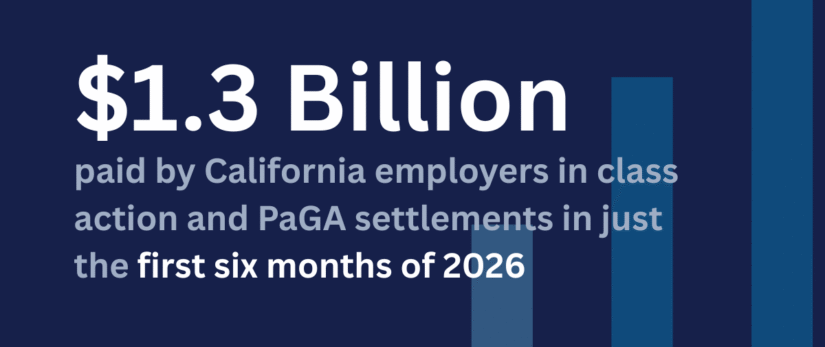
1. PAGA and class action settlements totaled $1.3 billion in the first six months of 2026.

That is not a typo. Across the roughly 1,400 to 1,500 settlements we tracked in the first half of the year, employers paid out approximately $1.3 billion — averaging about $219 million per month, and that figure is likely to grow because June’s numbers are still filling in as the LWDA continues posting settlement documents. I knew the number would be large, but when I first pulled it I double-checked it because I did not expect it to be that large. And the filings are not slowing down: PAGA notices filed with the LWDA are averaging about 849 per month, which puts 2026 on pace to exceed 10,000 notices and potentially become the biggest year yet for PAGA filings — two years after the reform that was supposed to slow this litigation down. For most companies operating in California, this is likely the single biggest source of exposure on the employment law front.

2. Smaller employers are now squarely in the crosshairs.

This was one of the most eye-opening findings in the data: 44% of the settlements in 2026 cover fewer than 200 employees, with the largest concentration of cases involving employers with 50 to 200 employees. The conventional wisdom that plaintiffs’ firms only chase large companies is out of date. The larger employers have increasingly dialed in their compliance — using software to track time records and limit violations — so plaintiffs’ firms have been moving down-market to smaller employers who often have fewer compliance systems in place. And geography is no protection either: while these cases have historically been centered in Los Angeles, San Francisco, and San Diego, we are seeing them expand well beyond the major metropolitan areas, aided by remote court appearances that make it easy to litigate in any jurisdiction. If you have 100 employees — or fewer — in California, do not assume you are not a target.

3. Most settlements are not the blockbusters that make headlines.

The million-dollar and five-million-dollar settlements get the press, but they are not representative. About half of the settlements in the first half of 2026 came in under $500,000, and the most common range is $100,000 to $500,000. Simple math on the totals (roughly $1.3 billion across roughly 1,400 to 1,500 settlements) produces an average near $900,000, but that average is skewed upward by a handful of very large cases — the typical case settles for far less. When we analyze these cases for clients, the total settlement amount actually tells you very little. The metrics that matter are the dollars per workweek for class claims and dollars per pay period for PAGA claims — that is how you compare apples to apples, and it is how your defense counsel should be benchmarking any settlement discussion. This data exists, and your attorney should be using it rather than relying on gut feel about what these cases “usually” settle for.

4. It takes about two years from PAGA notice to settlement.

On average, roughly two years pass between the filing of the PAGA notice with the LWDA and the filing of the settlement documents — and that figure has held remarkably consistent. This has two important implications. First, it means the effects of the June 2024 reform are only now beginning to show up in the settlement data, because the post-reform cases are just starting to reach resolution. Second, and more practically: time is money in these cases. Every additional month of litigation adds pay periods and workweeks to the potential exposure. If there is any realistic chance a case will settle, employers should push for early mediation — and start that process early, because mediator availability can run many months out. Cutting off the accrual of pay periods early should translate directly into a lower settlement. If early settlement is not realistic, then commit to litigating and building your defenses — but make that strategic decision deliberately, not by default.

5. Five plaintiffs’ firms account for roughly 40% of all settlements.

The PAGA landscape is remarkably concentrated. The five most active plaintiffs’ firms are responsible for about 40% of the settlements in 2026 — and slightly over 40% of the settlement dollars. These are highly specialized, volume-driven practices focused almost exclusively on wage and hour claims, and the concentration has only increased since the 2024 reform. This matters for employers in two ways. First, knowing the track record of the firm on the other side — what they settle for, what arguments they make, and how they run their cases — is valuable intelligence that should shape your defense strategy before you ever walk into a mediation. Second, these firms typically send cookie-cutter PAGA notices that list nearly every Labor Code provision without specifying what the employer actually did wrong — an issue the proposed LWDA regulations working their way through the process this year may finally address.

The bottom line: the 2024 reform did not end PAGA litigation, but it did fundamentally change how employers can defend these cases. The penalty caps — 15% if you took all reasonable steps before receiving a PAGA notice, 30% if you take them within 60 days after — are powerful tools, but the burden is on the employer to prove those steps with documentation. Regular payroll and time-record audits, compliant written policies, supervisor training, and corrective action are the four pillars, and they need to be documented, recurring practices — not a one-time event. With $1.3 billion on the table in just six months, taking those steps now is the best investment a California employer can make.

The slides from the masterclass are available upon request, and we publish a monthly report on PAGA and class action settlement trends through Scaled Comp for those who want to follow the data.

The post Five Numbers That Tell the Story of California PAGA and Class Actions at the Mid-Year Mark of 2026 appeared first on California Employment Law Report.

Read More →

Credit Report Damage Is Negotiable — If You Negotiate

Pay-for-delete isn’t in any statute, but it happens every day because tradelines are just data the furnisher controls. Settlement negotiations are the moment of maximum leverage to demand deletion. After you pay, your leverage is zero.

Sequence matters: deletion terms first, payment second. Always in writing.

Don’t pay a lawyer to find out what your rights are. Go to JusticePrompt.com and get the free kit. No credit card. No upsell. Just the documents and the law.

Read More →

You Won. Now Collect: The Judgment Creditor’s Toolbox

A California judgment is not a check — it’s a hunting license, valid ten years and renewable (CCP §683.020, §683.110), accruing 10% simple interest under §685.010 while you work it. Small-claims winners, wage claimants with unpaid awards, deposit plaintiffs: this is the machine.

Find the assets first. The debtor’s examination (CCP §708.110) hauls the debtor into court, under oath, to answer questions about accounts, employers, and property — with a bench warrant available for no-shows. In small claims, form SC-133 (statement of assets) is mandatory from a non-paying debtor. Subpoenas can reach banks directly.

The wage garnishment. Apply for a writ of execution (form EJ-130), then an earnings withholding order (form WG-001) served by the sheriff on the employer — collecting up to the CCP §706.050 cap (roughly 20% of disposable earnings) every payday until satisfied. Slow, steady, and demoralizing to debtors, which is why it produces settlements.

The bank levy. The same writ directs the sheriff to sweep identified accounts — timing matters (post-payday levies collect best), and exempt floors under §704.220 will protect a baseline amount.

The real property lien. Record an Abstract of Judgment (form EJ-001) in every county where the debtor owns or might own real estate — a §697.310 lien that waits silently for the sale or refinance and gets paid through escrow with a decade of interest.

Business debtors: the till tap and keeper (sheriff collects the register receipts) reach cash businesses; judgment liens on personal property file with the Secretary of State (§697.510).

Costs come back: filing, sheriff, and recording fees add to the judgment via memorandum of costs (§685.070).

The courts’ collection self-help guide maps every form. Most judgments go uncollected because winners stop at the verdict. The statute book assumed you’d keep going.

Every letter, form, and deadline referenced above is packaged in the free kits at JusticePrompt.com. No credit card, no upsell — the documents and the law, ready to use.

Read More →

Tip Theft, Uniform Costs, and the Small Deductions That Add Up

Employers can’t take your tips, charge you for required uniforms, or dock pay for register shortages in California. These ‘small’ deductions are wage theft with full penalty exposure, and they’re epidemic in food service and retail.

Five dollars a shift is $1,300 a year — before penalties triple it.

Don’t pay a lawyer to find out what your rights are. Go to JusticePrompt.com and get the free kit. No credit card. No upsell. Just the documents and the law.

Read More →

Default Judgment Against You? CCP 473.5 and the Art of the Do-Over

Tens of thousands of Californians carry judgments from lawsuits they never knew existed — garnishments arriving as the first notice of a case “served” years earlier. The law’s answer is a set of vacatur statutes, and they work more often than people expect.

The main tool: CCP §473.5. When service of a summons did not result in actual notice in time to defend, the defendant may move to set aside the default and default judgment. The deadline is the earlier of two years after entry of judgment or 180 days after service of written notice that the judgment has been entered — so the clock demands speed once a levy or garnishment surfaces the case. The motion requires a declaration that the lack of notice wasn’t caused by your own avoidance of service, plus a proposed answer showing you have defenses.

The nuclear option: void judgments. A judgment entered without valid service at all is void, attackable under CCP §473(d) — and where the invalidity appears from the court’s own file, without the two-year limit. “Sewer service” — the process server’s proof claiming personal delivery at an address you’d left years earlier, or describing a person who doesn’t exist — is a documented industry pathology, and proofs of service can be contested with leases, utility records, and DMV history showing you lived elsewhere.

The discretionary route: CCP §473(b) relieves defaults taken through mistake, inadvertence, surprise, or excusable neglect, on a six-month clock — the tool when you were served but life intervened.

Why plaintiffs fold when these motions file: vacating the default resurrects the case — and with it, every defense that default suppressed: the §337 statute of limitations, chain-of-title failures under Civil Code §1788.60, identity errors. A debt buyer holding a 2019 default on a 2015 debt does not want a 2026 trial. Vacated cases settle or die.

The sequence when a mystery garnishment lands: get the case file from the court same-week; obtain the proof of service; gather your address history for the service date; move fast — the 180-day clock is running. The courts’ vacate-judgment self-help pages include the forms. A default is a verdict on your absence, not the facts. California lets you correct the absence.

Every letter, form, and deadline referenced above is packaged in the free kits at JusticePrompt.com. No credit card, no upsell — the documents and the law, ready to use.

Read More →

What Happens When You Actually Show Up

Courtrooms in collection cases are empty of defendants. The day you appear — answer filed, documents demanded — you become the rare case that costs money to litigate. Plaintiff’s counsel carries hundreds of files; contested ones get settled or dumped.

Showing up is 80% of consumer defense. The kits handle the other 20%.

Don’t pay a lawyer to find out what your rights are. Go to JusticePrompt.com and get the free kit. No credit card. No upsell. Just the documents and the law.

Read More →

Certified Mail and Evidence Code 641: Three Dollars of Litigation Insurance

Half of consumer law is substantive rights. The other half is proving the other side received your letter — and California hands you that proof for the price of postage, through a presumption most people have never heard of.

The mailbox presumption. Evidence Code §641: a letter correctly addressed and properly mailed is presumed to have been received in the ordinary course of mail. The presumption shifts the burden — the recipient must produce evidence of non-receipt, and a bare “we never got it” from a company that processes thousands of letters rarely persuades. Pair the presumption with a certified mail receipt and the signed green card (or USPS electronic delivery confirmation) and “we never received your dispute” stops being a defense and starts being an impeachment exhibit.

Where this single habit decides outcomes:

The FDCPA validation demand under 15 U.S.C. §1692g — the entire cease-collection mechanism turns on the collector having received your dispute within the window. The Labor Code payroll-records request — the 21-day clock and $750 penalty of Labor Code §226(c),(f) run from receipt of your written request. The tenant’s habitability notice — the reasonable-time-to-repair clock of Civil Code §1942, and the retaliation presumption of §1942.5, both anchor to a dated, provable notice. The security-deposit demand, the credit bureau dispute under 15 U.S.C. §1681i (a 30-day reinvestigation deadline that only exists if receipt is provable), the small-claims pre-filing demand required by CCP §116.320.

The protocol, standardized: every consequential letter gets (1) a date, (2) a subject line identifying the account or unit, (3) certified mail with return receipt (add regular first-class in parallel — belt and suspenders, and it strengthens the §641 presumption), (4) a copy retained with the receipt stapled to it, and (5) a calendar entry for the deadline the letter started.

Litigation is a contest of records pretending to be a contest of arguments. Three dollars at the post office counter buys the record. It is the best-priced insurance in American law.

Every letter, form, and deadline referenced above is packaged in the free kits at JusticePrompt.com. No credit card, no upsell — the documents and the law, ready to use.

Read More →

The Deadline Is the Whole Case

Thirty days to answer a summons. Thirty days to demand validation. Twenty-one days for your deposit. Seventy-two hours for final wages. Three years on most wage claims, four on written contracts. Miss the window and the best facts in the world won’t save you.

Every kit on JusticePrompt leads with the calendar, because the calendar decides cases.

Don’t pay a lawyer to find out what your rights are. Go to JusticePrompt.com and get the free kit. No credit card. No upsell. Just the documents and the law.

Read More →

The Fee Waiver: How FW-001 Opens the Courthouse for Free

Court fees are the quietest access barrier in the system — $225 to $435 just to answer a complaint, more for motions, jury fees, sheriff’s service. California’s response is one of the most generous fee waiver regimes in the country, and it’s underused because people assume they won’t qualify. Run the actual test.

Three independent paths to qualification, under Government Code §68632:

Path one — public benefits: receiving CalFresh (SNAP), Medi-Cal, SSI/SSP, CalWORKs, County Relief, or IHSS qualifies you automatically. Check the box, done.

Path two — income: gross monthly household income at or below 125% of the federal poverty guidelines (the current dollar chart is printed on the form itself and updated annually).

Path three — need: even above those lines, a waiver issues if paying fees would leave you unable to pay for the common necessaries of life — rent, food, utilities, transportation — shown with a simple income-and-expense statement.

What it covers: filing fees (first papers, answers, motions), sheriff’s fees for serving papers and levying under writs, court reporter fees for hearings, and telephone appearance fees — the full procedural toolkit, not just the entry ticket (Gov. Code §68631).

The mechanics: file form FW-001 with your first papers; the clerk must accept your filing immediately, and the waiver is ruled on within five days — no ruling in time means fees are waived pending decision. Denials come with a hearing right. The courts’ fee waiver self-help pages walk every step.

The fine print worth knowing: if you win money, the court can recoup waived fees from the recovery — a fair trade for access. And the waiver travels with the case, covering fees as they arise.

Why this matters strategically: the default-judgment industry is financed by defendants who never answer, and the answer fee is a real part of why. For a household on CalFresh, the entire machinery of defense — answer, motions, service, even enforcement of a judgment you win — runs at zero cost. The Legislature already paid your ticket. Use the seat.

Every letter, form, and deadline referenced above is packaged in the free kits at JusticePrompt.com. No credit card, no upsell — the documents and the law, ready to use.

Read More →

Why Businesses Choose ABC Over Chapter 7

Speed: weeks, not a year. Privacy: no federal docket. Control: you choose the assignee. Cost: a fraction of bankruptcy administration. For a small California business with more debts than future, an assignment for the benefit of creditors is usually the cleaner funeral.

The creditors kit explains when it fits and when it doesn’t.

Don’t pay a lawyer to find out what your rights are. Go to JusticePrompt.com and get the free kit. No credit card. No upsell. Just the documents and the law.

Read More →